Retired. Disabled Veteran. Democrat. Cancer Survivor. Stroke Survivor. Radical. Socialist. Non-theist. Political Activist. Witty Impromptu Comedian. Writer. Professional Pain in the Ass. Class Warrior.
And Smart-Mouth Dispenser of Political Snark.
About Me
Farnsworth68
The Left Coast, United States
Farnsworth is a disabled Vietnam Veteran with a bad attitude and too much time on his hands.
Also available in EPUB electronic format from Barnes and Noble, and for cheap! -- Just $3.59.
If you buy an electronic version, I will personally come to your house and inscribe with an icepick an autograph on the screen of your reader! How can you pass that up?
If you buy something from Amazon by going through this portal, I get a few pennies reward on each purchase.
Portable OPOVet
Get the portable One Pissed Off Vet for Android -- click on the image to download.
What Breed of Liberal I Am
My Liberal Identity:
You are a New Left Hipster, also known as a MoveOn.org liberal, Netroots activist, or Daily Show fanatic. You believe that if we really want to defend American values, conservative hatriots must be exposed and mocked for every fanatical, puritanical, soulless, paranoid, fact-free, obstructionist ideal for which they stand.
"I don't see why we need to stand by and watch a country go communist due to the irresponsibility of its people. The issues are much too important for the Chilean voters to be left to decide for themselves."
-- Henry Kissinger
"When you give food to the poor, they call you a saint. When you ask why the poor have no food, they call you a communist."
-- Archbishop Helder Camara
"It is a truism that almost any sect, cult, or religion will legislate its creeds into law if it acquires the political power to do so, and will follow it by suppressing opposition, subverting all education to seize early the minds of the young, and by killing, locking up, or driving underground all heretics."
-- Robert A. Heinlein
"Those who can make you believe absurdities can make you commit atrocities."
-- Voltaire
"If you don't stand for something you will fall for anything."
-- Malcolm X
"The less justified a man is in claiming excellence for his own self, the more ready he is to claim all excellence for his nation, his religion, his race or his holy cause."
-- Eric Hoffer
"When fascism comes to America, it will be wrapped in the flag, carrying a cross."
-- Sinclair Lewis
"Secular schools can never be tolerated because such a school has no religious instruction and a general moral instruction without a religious foundation is built on air; consequently, all character training and religion must be derived from faith.... We need believing people."
-- Adolph Hitler
"I believe in an America where the separation of church and state is absolute--where no Catholic prelate would tell the President (should he be Catholic) how to act, and no Protestant minister would tell his parishioners for whom to vote -- where no church or church school is granted any public funds or political preference -- and where no man is denied public office merely because his religion differs from the President who might appoint him or the people who might elect him."
-- President John F. Kennedy
"To assert that the earth revolves around the sun is as erroneous as to claim that Jesus was not born of a virgin."
-- Cardinal Roberto Bellarmine, 1615, during the trial of Galileo
"Christian Fundamentalism: The doctrine that there is an absolutely-powerful infinitely-knowledgeable universe-spanning entity that is deeply and personally concerned about my sex life."
-- Andrew Lias
"When a man is freed of religion, he has a better chance to live a normal and wholesome life."
-- Sigmund Freud
"All wonder is the effect of novelty upon ignorance."
-- Samuel Johnson
"Those who give up liberty for security deserve neither and will lose both."
-- Benjamin Franklin
"It is in no way lawful to demand, to defend, or to grant unconditional freedom of thought, or speech, of writing, or of religion, as if they were so many rights that nature has given to man."
-- Pope Gregory XVI (1831-1846)
"There is no need to sally forth, for it remains true that those things which make us human are, curiously enough, always close at hand. Resolve, then, that on this very ground, with small flags waving and tinny blasts of tiny trumpets, we shall meet the enemy, and not only may he be ours, he may be us."
This is probably the very worst anti-marijuana movie in the genre. It's not even close to Ed-Wood-so-bad-it's-good bad, it's just bad bad. Even so, there's some unintentionally funny stuff, such as Oliver the elderly hot-dog vender with a cart right across from the high school, who serves "stacks" of weed with his hot dogs, and pudgy Sam, the head gangster's right-hand man.
There's also a party with your typical long-in-the-tooth "teenagers" where marijuana is smoked and, as you know always happens at marijuana parties, a riot breaks out. "Good girl" Kay O'Farrell ends up going undercover for the cops to bust the local drug lord, Larry McGuire -- who of course has a pencil-thin mustache!
It's an undercover operation that lasts for months -- you can literally see the days falling off the calendar -- and ends abruptly with the cops arriving late to the party, after Larry has been shot by another gangster who has just gotten out of prison and wants to take over the business.
There's surprisingly little pot smoking in this movie -- just at the wild party near the start of the film.
The money shot: A bit of skivvy dancing at the early "loco weed" party, and good girl dancer Kay shows a bit of thigh a couple of times. There may be a bit of nudity in a distant shot of another female dancer at the club but it's hard to tell.
Lessons learned: "Whoever named that stuff 'loco weed' sure knew what they were talking about." (actual quote from the "kindly" police lieutenant)
Directed by: Ray Test (his only film).
Taglines: A Vicious Racket With It's [sic] Arms Around Your Children! A fifth column sowing destruction in the youth of America, A good girl until she lights a "reefer", The truth about MARIJUANA the smoke of Hell!
The 1930s produced a cornucopia of grindhouse exploitation films (aka "sexploitation" movies), usually disguised as "educational" movies that were ostensible cautionary tales about one social problem or another.
This is another huge hot mess from Dwain Esper, the "King of the Celluloid Gypsies".
While it's kind of hard to tell what's going on in any given scene, the whole thing is a forced march through the many manifestations of 1930s ideas of insanity, with explanatory titles popping up periodically to tell us about things like Dementia Praecox, Manic-Depressives, and Paranoia.
Briefly, it's about a mad doctor, his crazy assistant and a large variety of sex-infused craziness. We're thrown a lot of wacked out stuff in a short period of time, including the weird goon of a neighbor who raises cats and rats. He has a thousand of each -- cats for the fur, rats for the cats to eat, and the rats in turn eat the corpses of the cats after they've been skinned, a nifty self-contained backyard entrepreneur operation.
There's a lot of emphasis on cats in this movie, including cats fighting in a funeral home(?), a cat that gets his eye gouged out and eaten(!) by the crazy assistant -- who has killed the mad doctor and assumed his persona -- and two women in a hypodermic-syringe-weapon "cat fight" in the cellar.
Wikipedia says that the plot is loosely based on "The Black Cat" by Edgar Allen Poe. Okay.
Along the way there's a lot of scenery-chewing hyper-thespianism by pretty much everyone involved, especially the mad doctor in the opening scenes. It's been heralded by several sources as the "worst movie ever made". I can believe it.
The money shot: Several of them, all of them completely gratuitous, including the simulated rape of a nude zombie girl, several "examinations" of women in various stages of undress by the mad doctor/crazy assistant, and a "meanwhile back at the ranch" scene with the crazy assistant's ex-wife and her skeezy female roommates in which everyone prances around in their briefest skivvies. I told you it was a hot mess...
Lessons learned: Beats me.
Directed by: Dwain Esper, whom we have seen before on this blog.
Taglines: He menaced women with weird desires! A Subject Seldom Discussed, True and Authentic/Nothing Withheld, Strange Loves Exposed, What Are the Dangers of Desire? What Wrecks Romances? The Truth About Love Fearlessly Told
A sub-genre of the exploitation movie was the pseudo-documentary, providing a "non-judgmental" view of some exotic locale or practice. Bali was a hot topic since it had beautiful women who generally went topless, and "real life documentaries" filmed there in the early 1930s held a tittilating grip on the American movie-going audience. See Virgins of Bali, for an example.
Also popular were "real looks" at the worldwide nudist movement, which brings us to this week's feature, This Nude World from 1933:
Full movie:
Considered one the first "nudist documentaries", unfolding with a straightforward narration in a voice that's a clone of the famous Lowell Thomas, this movie promises a peek into the world of "naturists" in their natural habitat.
Surprisingly, it actually delivers, with sequences shot at a nudist camp in the Catskills, one outside of Paris in France, and finally one in Germany which exists in Berlin itself as well as in the forests outside the city. Since it is in B&W and doesn't feature full frontal nudity, since it's mostly long and medium shots, (and since you can't avoid thinking about seeing your grandmother naked), it's not very tittilating. Lots of full "backal" nudity, though, and an interesting look at the nudists of the very early 30s.
I am assuming that the German portion of the movie was filmed prior to the Nazis coming to power, for reasons that will become obvious as you view that section.
The money shot: A spliced-in shot of a naked girl walking up a short steep hill and then turning to walk back down again. The only full frontal in the movie, and it's obviously taken from some other film, since it doesn't really fit in here. Even the film stock is different.
Lessons learned: "Nudism is a healthy lifestyle, but it may not be for you." This is explicitly stated at the end of the movie.
Directed by: Mitch Minden, who also directed Hitler's Reign of Terror, called the "first ever American anti-Nazi film". This film itself has an interesting history. It was shot by Cornelius Vanderbilt, Jr. (yes, of those Vanderbilts) on a trip to Germany, and then put together by Minden. It was believed lost for 70 years until a copy showed up recently in Belgium. As far as I can tell, it's not available over the Internet, but you can see a short "news mcnugget" on it here. It is not known how Vanderbilt decided to hire Minden as director.
Taglines: "Authentic Trip Through an American Nudist Colony!" and "Guaranteed the Most Educational Film Ever Produced!"
Also known as Back to Nature, The Nudist World, This Naked Age, This Naked World
Did you ever wonder where I get the information on those exploitation movies that I've been featuring on a weekly basis since February of this year? And why I've been running them?
Well, there is the fact that I've been a big fan of the genre since I was a callow youth of 18 or so and my buddy and I drove down to an "art film" (aka "grindhouse") theater on the sleazy side of downtown Portland OR circa 1963 to watch something called Hitchhike to Hell, a cautionary tale about young girls lured into prostitution in a remote area of what appears to be the desert of Eastern Oregon, a film which later turned out to be considered a demi-classic of the genre -- I can't seem to find a copy available for download or streaming, though. Added to that frustration is the fact that the struggle of searching for any particular exploitation film is exacerbated by the fact that most of them were released under a variety of titles. For instance, Hitchhike to Hell also appeared as Highway Girls, Highway Hell, Hitch-Hike to Hell, Going My Way Mister? and Honky Tonk Girl. They could appear under any of these titles.
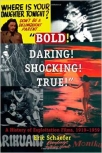
"Bold! Daring! Shocking! True!" a detailed historical examination, combined with an incisive academic analysis, of the many manifestations and permutations of the genre throughout the Golden Age of exploitation films. It breaks out into separate chapters the many subgenres of exploitation films (e.g., Sex Hygiene, Drugs, Vice, Exotic and Atrocity, Nudist and Burlesque) and provides many detailed descriptions of the films in each category. It also deals with such issues as production, distribution, advertising, exhibition and censorship of these films.
The history of the exploitation film is longer than I thought, going back, in the very early days, to some of the very first films by the Edison lab kinetiscope and Edweard Muybridge, who started making motion pictures of "naked ladies" right after he was done filming running horses for Leland Stanford so he could win a bet.
Some wag said that the first movie was a train going though a tunnel, and the second movie was some guy "reenacting" that with his girlfriend...
It also has a lengthy appendix of some 42+ pages listing all of the exploitation films that Schaefer could dig up information on. He did a ton of research on this but even he admits that he hasn't seen all of the movies listed here himself, since many of them seem to be lost. However, enough people did manage to both see them and write enough about that experience, so Schaefer can speak with some authority on them.
This book is highly recommended for anyone who is a fan of the genre, or a fan of movies in general, or of the history of movies, or of the history of morals and manners in the first half of the 20th Century.
Plus it is profusely illustrated with actual stills from the movies, many of them of a salacious nature, and copies of advertising posters.
Note: If you buy this book, or anything else from Amazon (through the search portal in the left-hand column), they'll kick back a few cents to me. I figure that this is the most user-friendly way to get some money out of this blog. I certainly don't want to "monetize" it by allowing Google to throw up some random ads. Thank you for your support.
The 1930s produced a cornucopia of grindhouse exploitation films (aka "sexploitation" movies), usually disguised as "educational" movies that were ostensible cautionary tales about one social problem or another.
Today's feature is the over-the-top exposé of the evils of marijuana, Assassin of Youth from 1937.
Full movie:
This is one of the classics of anti-marijuana propaganda. Sweet girl Joan Barrie is left her grandmother's fortune, but with an odd morals clause. She has to remain "pure" or she doesn't get the money. This doesn't sit well with her blonde(!) scheming cousin, Linda, who sets out to ruin Joan's reputation so that she can get the money. Odd that the "morals" clause applies only to Joan, but never mind that.
Crusading cub reporter Art Brighton goes undercover to expose the danger of marijuana "right here in River City". We learn that marijuana is the worst drug ever, we are treated to a film-within-the-film lecture by a "noted expert" who lectures us pedantically that the word "assassin" comes from "hashish" (here's the Straight Dope on that) and was applied to a group of paid killers in "Syria and Persia"(?) who smoke the dreaded weed and become robotlike murderers. We are also treated to an overwrought recreation of an insane man's confession that he killed five people -- including his uncle! -- while he was under the influence of the "narcotic weed".
In the festive party atmosphere that surrounds the "kids" in this movie (as usual, a bunch of 25-year-old teenagers), Joan falls in the lake and has to take off her clothes to dry them, Linda "accidentally" sets the clothes on fire, and when they return to town Linda and her boyfriend/secret husband make sure that the town busybody sees Joan wearing nothing. Nothing, that is, but a long trench coat that covers everything.
Along the way Joan's little sister takes a few tokes off of some "reefer", goes into a psychotic breakdown, is subjected to some tsk-tsk-clucking by a narcotics-expert doctor, and lingers on in a semi-vegetative state. The reporter enlists Joan's help in exposing the local dope racket, a comedy scene occurs at the court when the judge is trying to render the will, and everything works out in the end: Art rushes in with his stop-the-presses exposé, Linda is exposed, Joan gets the money, and at the end of the movie she and Art are going to get married.
In short, take away all the drug references and it's just another soap opera.
Also notable, for comic effect: The stoned-out party guy, the town busybody Miss Frisbee and her scooter, and Pop Brady who owns the soda fountain where everyone hangs out when they are not partying. (Even though these are all supposed to be high school kids, we never see the school, never see them in class.)
For what it's worth, the innocent girl/lead character is referred to as "Joan Barry" in all the writeups on this movie, but she is listed as "Joan Barrie" in the credits.
The money shot: When she takes off her wet clothes at the lake we see Joan's white skivvies, and then we see her naked, more or less, in a profile silhoutte. There's also some dancing where the girls raise their skirts to mid-thigh and show some -- gasp -- stocking tops.
Lessons learned: Don't dare take that first reefer. And, since all the reefers presented in these movies look like ordinary cigarettes (nobody hand-rolled joints in those days, it appears), better not to smoke at all. And of course, it goes without saying, don't trust blondes.
The 1930s produced a cornucopia of grindhouse exploitation films (aka "sexploitation" movies), usually disguised as "educational" movies that were ostensible cautionary tales about one social problem or another.
Today we have the granddaddy of all exploitation moves, and certainly the most notorious. It's the celebrated Reefer Madness from 1936.
Full movie:
It has all the usual stuff -- 25-year-old high school students smoking the dreaded "reefer", hooked on it by nefarious members of a well-dressed gang who maintain an apartment "dope house" where the kids can come and take a break. It doesn't take long for things to fall apart -- as usual in these movies -- and we see in rapid succession the "violence" that marijuana is so well-noted for. A hit and run in a teenagers car is followed by an accidental shooting of the teenager's sister, while all the time we cut to shots of the piano player, "Hotfingers", getting more and more frantic as the dope hits him, and then even more insane when it wears off and he is desperate for his "fix".
It's so perniciously difficult to control because it grows wild in every state, we are told by the stern narrator, and for the addict, it is worse than heroin!
As a casual observer, I was struck by the amount of marijuana smoke being exhaled. It looked quite cinematic with the lights behind it, but nobody ever seemed to inhale it. It must have been some good shit if they all got that high just from a mouth hit.
The money shot: No nudity, but it's a treat to watch Hophead Ralph turn rapidly into rank, raving insanity from the effects of his addiction to marijuana.
Lessons learned: Don't take that cigarette, even if the person offering it looks trustworthy. Don't trust people in suits maintaining an apartment just for high school kids to hang out. And of course, the big boss of the dope ring has a mustache.
I first saw this in a smoke-filled art theater in Isla Vista CA, just off the UC Santa Barbara campus in 1974. The smoke was so thick that you could barely see the screen, and the audience was so loud with its catcalls that you could hardly hear the dialogue.
Directed by: Louis Gastner. The original move was a straight informative documentary-type presentation intended to "warn the children" until our old buddy, Dwain Esper got hold of it. He recut it to make it seem more salacious and bring in better box office on the exploitation circuit.
This is the film that went missing for 30 some years, until was rediscovered in the spring of 1972 by the founder of NORML, Keith Stroup, who found a copy of the film in the Library of Congress archives and bought a print for $297. It became an instant hit among the youthful college student hippie-types of the world. and it also ushered in a new Golden Era for exploitation films in general. It was named by film critics as one of the worst films ever made -- and when you look at the list, that is some impressive company..
Taglines: SEE youthful marijuana victims - what actually happens! Sin - degradation - vice - insanity! Tell your children! Women Cry For It - Men Die For It! The Sweet "Pill" That Makes Life BITTER! Adults Only! Drug Crazed Abandon! 65 years later, audiences are still hooked! It's Public Enemy, Number One!
Also known as Tell Your Children (Original title), Dope Addict, Doped Youth, Love Madness, The Burning Question
The 1930s produced a cornucopia of grindhouse exploitation films (aka "sexploitation" movies), usually disguised as "educational" movies that were ostensible cautionary tales about one social problem or another.
This week we present Damaged Lives from 1933, a "scared straight" cautionary tale about the dreaded social disease, syphilis.
Full movie:
Young upcoming shipping company executive/man about town, Donald Bradley, skips a date with his fianceé to go to a "business meeting" -- which just coincidentally is taking place at one of those swanky New York nightclubs -- where he hooks up with a blonde socialite, takes her home and the inevitable happens.
Normal one-night-stand. Except he also gets "it" from her. In a lengthy emotional scene the socialite tells Don that she has "it" and has passed "it" on to him. She can't quite bring herself to actually say it, but he gets the drift, and then she shoots herself.
Don gets married to longtime girlfriend Joan, and then a few months later the family doctor (played by Jason Robards Sr.) shows up at Don's office. After some arm-twisting they go to a "famous clinic" to confer with a "famous doctor", who breaks the dreaded news that both Don and Joan have ... syphilis! To make matters worse, Joan is pregnant!
There's a "scared straight" shock-walk through the clinic (footage obviously lifted from some medical documentary), where the doctor opens various doors for a little look-see at the patients, each of whom is worse than the last. Symptoms range from the minor "physical ataxia" (evidenced by continuous leg motions, like dancing) to the worst, a wheelchair-bound mental defective woman who has seven children, each of whom has separate but typical symptoms of congenital syphilis, in a laundry list ranging from mild retardation to death.
Back in their fancy-schmancy New York apartment, Joan is ready to end it all. She closes the curtains and the outside door, turns on the gas and waits for death next to a sleeping Don. Who wakes up just in time to open the door, turn off the gas, and convince Joan that they are getting the cure, their baby will be all right. Fade to black.
The money shot: None, although the Wikipedia article says, "noteworthy for containing one of the earliest filmed nude scenes in a sequence where a group of fun-loving women strip naked and go skinny dipping". I checked out several copies of this film and none of them have this scene. Moreover, there really isn't a logical place in this movie for this scene to have taken place. I think somebody got this wrong -- this description sounds more like
The 1930s produced a cornucopia of grindhouse exploitation films (aka "sexploitation" movies), usually disguised as "educational" movies that were ostensible cautionary tales about one social problem or another.
Despite the nudge-nudge-wink-wink nature of its title and tagline, this is a standard 1930s melodrama showing how two diametrically-opposed parenting styles can lead to destruction for two girls. On the one hand is Barbara "Babe" Webster, whose social-climbing divorceé mother is too busy and too detached to show her daughter any affection (she even abandons her on her birthday to go with "The Carlyles" to the seashore). On the other is our "good girl" Claire Elliott, the product of a single-father family (mother died at some earlier point), who has been raised very strictly with "too much" parenting.
These are the poles, and the movie takes great pains to point out that neither one is good for the children. Especially the daughters. We never get to know how old these girls are, but the implication is that they are 18 or so (played by 25-year-old actresses, naturally), old enough to head for the bright lights of the big city, New York, as runaways.
They meet Joe Gilman, the stock bad guy (you can tell because of the mustache) in a super fancy nightclub in their home town of Glenhaven MA -- what a fancy nightclub with a band is doing in this obviously one-horse town in Massachusetts is an open question, but as I've said before, these movies don't have to make sense. Joe Gilman has a fancy dress shop in NYC and tells the girls they can come to work for him and be "models".
Yeah, right. But, as it turns out, he really does have a fancy dress shop and he does give them jobs as models. But we quickly learn that it's just a front for his real business, which is extortion of the wealthy men whose wives shop at his store. It's a variety of the old Badger Game, and when Babe is talked into cooperating, she's smart enough to realize the potential for financial reward. Uh-oh. Naturally, since in these movies, "somebody" has to die, it's gonna be Babe.
The one unintentionally funny scene in this move takes place just outside NYC. In the San Gabriel Mountains overlooking San Fernando Valley. Babe goes over a cliff in a car to her death, with a little "help" from Gilman, but survives long enough for a "death scene" at the hospital -- presumably back in New York, since Claire is able to see her just before she expires.
It all gets wrapped up nicely, though, right after we think that Claire is doomed when she moves into a fancy apartment that costs ... $40 a month! But no, her boyfriend is a crusading reporter who blows the whole thing wide open with a "surprise" ending.
The money shot: None, even though they had ample opportunity -- the "modeling" scenes, the badger-game scenes, and the final scene, wherein our heroine appears in her "nighties", a pajama-looking thing which fully envelops her body, right down to the wrists.
Lessons learned: Parents, if you are too lenient or too strict, your daughters will come to a bad end. And, as ever, stay away from men with mustaches...
Directed by: Jean Yarbrough, who went on to have a successful career directing Abbott & Costello comedies and a number of television shows. Oddly, this movie does not show up in his filmography on his Wikipedia page.
Taglines: They paid a high price for the luxury and excitement they sought and got!
The 1930s produced a cornucopia of grindhouse exploitation films (aka "sexploitation" movies), usually disguised as "educational" movies that were ostensible cautionary tales about one social problem or another.
This movie is all about the base degeneracy that inevitably comes from gambling, including a slide into prostitution and murder when a girl can't pay her gambling debts.
The story begins with a police raid on a gambling club/brothel, a bunch of scanty-girls scrabble around to try to keep from being busted, and finally we see Mae Miller with a pistol in her hand, standing over the dead body of "Lucky" Wilder, the club owner.
The story is told in a series of flashbacks at police headquarters -- we see Mae, happily married to a struggling doctor, who wants the high life, the good things. At first she's willing to wait until he "makes it", but a small gamble on a boxing match that takes place at a garden party(!) where the women in her circle play bridge (these movies don't really have to make any sense) leads her to the posh gambling club of "Lucky" Wilder, where her "friend" Molly Murdock steers her into a roulette game that is rigged. Yeah, big surprise, that. But, in the time-honored "first one is free" tradition, it is rigged in her favor. Until she gets hooked on gambling and racks up $10,000 in IOUs. (According to the CPI Inflation Calculator, that's over $168,000 in today's money.)
From there the only way she can hope to pay any of that back is by becoming one of Lucky's "working girls". If you ask me, that's going to be a lot of "work". But she is apparently pretty skilled -- her first "date" nets her $1,000(!).
Finally, Lucky seduces and impregnates Mae's little sister Carolyn (who looks like she's about 16). She has an abortion -- which, naturally in these cautionary tales, kills her. After an over-the-top death scene at the hospital, Mae goes back to the club and shoots Lucky. Six times.
Mae's husband is one of those stick-by-your-woman guys and supports her throughout the "now" segments at the police station, complaining that the police ought to do something to shut down the evil that has enveloped the city. "I want my wife back," he says to the DA. "That's up to the judge and jury," the DA tells him. Fade to black.
The dead guy, racket boss Lucky Wilder, (his nickname is apparently meant ironically), may have been based on Charles "Lucky" Luciano, an American Mafia mob boss whose early career was featured in a major subplot in the terrific HBO series, Boardwalk Empire. Despite several brushes with death, a stretch in prison in the US and being deported to his native Italy, "Lucky" was lucky to the end, dying of natural causes (a heart attack) at the age of 64. Unlike most of his mob associates, most of whom checked out due to what was called with macabre humor "lead poisoning" -- like Lucky Wilder in this movie.
And get a load of this promotional poster:
[Note: Image from Wikipedia and is copyrighted;
it is used here under the "fair use" doctrine]
Jeez, who wouldn't want to see this movie?
The money shot: Right at the start of the movie, we see the "working girls" scampering around in their skivvies. No nudity, but the next best thing. Then there are a couple of "exotic dancers" at the club, and a hot black girl dancer at a "Negro" club in "the slums" who looks a bit like Josephine Baker in her prime.
Lessons learned: Don't bet money on anything, don't sign IOUs, stay away from all gambling, and don't trust a friend who wants to take you to a club.
Taglines: Rigorously Adults Only! Women of today sold into bondage! Actually adapted from authentic police records!See all (IMDB)
Directed by: Elmer Clifton, who also directed another exploitation film already featured in this series, Slaves in Bondage
The 1930s produced a cornucopia of grindhouse exploitation films (aka "sexploitation" movies), usually disguised as "educational" movies that were ostensible cautionary tales about one social problem or another.
This is another cautionary tale about a young girl whose life is ruined by sex and alcohol and marijuana. Typically, "good girl" Ann Dixon and her high school friends are 25-year-old teenagers, and we know the first time we see her best friend Eve that she is trouble. How do we know that? She's a bleach-blonde.
She's also a "fast girl" who uses some subtle peer pressure to get Ann to take that first drink, a leftover from a party thrown by her divorceé mother. (In these movies, a child of divorce always = trouble.)
From there, of course, it all goes rapidly downhill as Ann has some crying-afterwards first sex with her "teenage" boyfriend, and then hooks up with Ralph, an "older man" (i.e., about 30 -- only three years older than Helen Foster, the actress who plays teenage Ann) . She falls in love with him, he slips her a mickey of some sort and they "do it" on his couch after he discreetly switches off the light.
Then there's a wild party at the house of one of Ralph's friends, they all play a game of strip craps (I guess it was faster for the whole getting-the-clothes-off thing to show strip craps rather than strip poker), Eve loses all of her clothes, and then someone suggests they take a dip in the pool.
No one has a swimsuit (of course) so the girls, already in their 1930s skivvies, jump into the pool with guys who don't look like they've taken anything off except their shoes and jackets. Eve, already naked, takes a swan dive off the board. A couple of uptight neighbors are outraged, call the cops (while the man -- comic relief -- keeps peeking out the window wearing a broad leer, "to keep an eye on things") and when the cops show up Ralph sneaks off and leaves Ann to face the music on her own.
At the police station Eve and Ann are labeled as "sex delinquents" -- really; we see their official cards -- and they are detained for an "examination" by a doctor. Ann passes her Wassermann Test but Eve doesn't. Ann's mother shows up to take her home, leaving Eve behind because her mother is "out of town" (i.e., she's at a wild party herself and can't be located).
Even though Ann managed to pass that Wassermann, she is still not off the hook -- not by a long shot: She is pregnant. She tells Ralph about it and he hems and haws and says he will marry her, but not now since he's "not free". He convinces her to get an abortion from the slimiest-imaginable "doctor", and then we fast forward to the death scene. Spoiler alert: She dies from complications from this "doctor" and his botched butchery.
One modern critic called this a "sordid drive down the path of moral and physical degradation, capped off with just enough of a moral lesson to alleviate any guilt the viewer might feel for watching such a decadent display."
I was actually surprised by the amount of professionalism shown here. There's some pretty good movie-making going on, especially in the first half, in spite of all the hand-wringing sensationalism. The actors do the best they can with a raft of wooden dialogue, especially the moralizing social worker in the "girls division" of the justice system who lectures Ann's mother on her lack of child-raising skills. Yes, of course it is the fault of the parents -- that's who this "educational" movie was aimed at. In fact, the producers billed it as suitable only for persons over 18.
Turns out it was a remake of a 1928 silent film of the same name, also starring Helen Foster in the main role. I haven't been able to find a copy of it, but there are reports that it was way more salacious than this version.
The money shot: The pool party -- girls in wet underwear and Eve doing her naked dive.
Lessons learned: Don't take that first drink, don't have sex, and if you get pregnant don't have an abortion. Especially not from some sleazy "doctor" with a leer fronted by a mustache! Oh, and of course don't trust blonde girls... Ever.
The 1930s produced a cornucopia of grindhouse exploitation films (aka "sexploitation" movies), usually disguised as "educational" movies that were ostensible cautionary tales about one social problem or another.
Today we have a snooze-fest from 1938 entitled Delinquent Parents:
Full movie:
This one is so lame that it doesn't even have its own Wikipedia page. But it does have a grabber poster:
And some killer taglines: Under Age! Out of Control! A Picture You Will Never Forget... Modern Youth In Revolt!
The plot, such as it is, first focuses on a girl law student who gets pregnant and chooses to give her "illegitimate" daughter up for adoption, and then has to keep it secret from her husband and friends later in life. You can guess how well that works out for her. She becomes a judge(!) and that baby comes back to haunt her: We see the baby all grown up and when she finds out she's adopted, she goes "youth crazy". Blah blah blah.
The money shot: There really isn't one. A girl is seen dancing in wild abandon, lifting up her skit so we can see -- gasp! -- her thighs! That's her in the circle on the poster.
Lessons learned: Don't get pregnant, stay out of trouble with the law unless you can snag an "understanding" judge, don't dance like that. Oh, and if you are adopted, don't panic out and turn into an "underage and out-of-control youth". Get over it.
The 1930s produced a cornucopia of grindhouse exploitation films (aka "sexploitation" movies), usually disguised as "educational" movies that were ostensible cautionary tales about one social problem or another.
Today we have The Cocaine Fiends, originally released under the title The Pace That Kills, another morality tale involving dope and at-risk youth (are there any other kind in these movies?).
Full movie:
Pretty but innocent (aren't they all?) Joan Bradford works at her mother's restaurant on a busy highway in the country. A traveling salesman/dope pusher stops by while he's on the lam from the cops and offers her a "headache powder". You can figure out right there where this is going, and it doesn't disappoint that expectation.
Joan falls in love with the guy and heads for the bright lights of the big city, keeps taking those headache powders, and eventually becomes Lil, a "gangster's moll". In the meantime, Joan's even-more-innocent younger brother is working as a carhop(!) at a drive-in restaurant (the iconic Twin Barrels in Los Angeles*) with a blonde girl co-worker who introduces him to some "pick-me-ups" in the form of that now infamous headache powder.
Things go along and we watch intercuts between the sad mother back in "the country", waiting in vain for a letter from her wayward children, and the brother and sister, each of whom is in the thrall of addiction independently of the other. Some stretched-out spiraling-the-drain stuff occurs, the brother's blonde girlfriend from the drive-in, looking especially haggard, becomes a streetwalker to supply his raging habit (now he's evidently shooting up), she eventually commits suicide after she gets pregnant and he says he never loved her, and finally there's a "surprising" plot twist at the end.
Oh, and a couple of people do end up happily ever after, a rich girl we see slumming at -- and kidnapped from -- the Dead Rat Cafe, who can't understand why she isn't acceptable in "society" (there's a reason for that, having to do with that plot twist) and her beau/watcher/protector, who is actually a lieutenant in charge of the vice squad who is working "undercover".
About the only high point here is that Dead Rat Cafe, situated on a sleazy non-descript alley in the "bad part of town". As we hear early on, when girls end up there it's the end of the road for them. But when we finally get to actually see inside the Dead Rat, it turns out that it is a swanky-looking nightclub with a live band and a floor show! Two of the floor-show singers actually get to sing, which kind of makes this a musical. Sadly, they aren't very good singers,which is, I presume, how they ended up in this dog of a movie.
The money shot: There isn't one. The sex is all implied, there's no nudity, and while there are plenty of drugs -- cocaine and opium -- we never see anyone actually using -- the camera would cut away to a reaction shot instead. The raciest thing about this movie is the original poster:
If, based on that poster, I'd gone to see this movie in a theater, I'd demand my money back.
Lessons learned: Don't take that first "headache powder" if someone offers it to you, not even a beautiful blonde, stay away from the city if you are from the country, and don't trust anybody...
* The Twin Barrels drive-in was legendary to the generation that came of age when "cruising" was a thing. For those not in the know, in the late 1950s and early 1960s, kids in hot-rod cars would spend a whole night cruising "the strip", from one drive-in to another, for no particular reason, other than to see and be seen and show off their cars. This social milieu was captured perfectly in the coming-of-age movie of my generation, American Graffiti. Given its legendary status, it's kind of surprising that I couldn't find much on the Interwebs about the Twin Barrels except that matchbook cover.
The 1930s produced a cornucopia of grindhouse exploitation films (aka "sexploitation" movies), usually disguised as "educational" movies that were ostensible cautionary tales about one social problem or another.
Here from 1937 is Slaves in Bondage. The title alone ought to explain it all.
Full movie:
Yeah, it ought to, but about the most titillating thing about this movie is its name. The phrase "White Slavery" is a titillatingly catchy early-20th-Century name for sexual slavery and human trafficking. Thanks to the Yellow Journalism of the media of the time, It was actually a socially-shocking Very Big Deal back in the 1920s and 1930s, and this movie exploits that to the hilt: Young girls lured into prostitution by answering an innocuous ad in a small-town newspaper for "manicurists" -- attractive girls only, no experience necessary. Apparently that wasn't enough to bring up any warning signals, since the manicure shop that fronts as a prostitution recruitment center doesn't seem to have any lack of applicants for the jobs. The "job interviews" are unintentionally funny: "I'm sure we can find some ... 'work' ... for you..." after the chief manicurist/procurer named Belle, played as a hard blonde, looks them over from head to toe.
This movie really has a little "something for everyone": A smart-but-naïve girl, a young gung-ho wanna-be reporter, a couple of male acrobats who act out some faintly homoerotic tumbling routines in a boarding house living room, and a sexual smorgasbord at the roadhouse/brothel/nightclub that a customer can choose from, including a couple of -- shock! -- "fetish Lesbian spanking" girls. You pays your money and you takes your choice...
This movie doesn't even pretend to be "educational" ; there's no crawling text -- the so-called "square-up" disclaimer -- at the beginning, and the closest it comes to any kind of lesson is when a grumpy detective lectures the weary seen-it-all editor about it being "the same old story" with the ads in small-town newspapers luring innocent country girls to the bright lights of the big city.
After some boring and kind of confusing subplots featuring pasteboard characters in this cheap mess, a fleeting glimpse of the head Bad Guy (all the bad guys have mustaches!) with his hand on -- again, shock! -- Good Girl Dona's breast, and a fight scene in the nightclub that looks like it was lifted from a Mack Sennett comedy, it all ends well with Dona and the wannabe reporter getting married, him getting a job at the paper, the bad guys going to jail, and everyone living happily ever after.
Except for the "manicurists". After they've served their purpose by parading around in their skivvies -- I guess you could call some of it lingerie -- in several scenes, and acting as sadly comical spanking Lesbians, we don't hear any more about them. Like most of the women in these movies, they are ultimately disposable.
Sidebar: It is not my intention to make light of the very real problem of Sex Slavery and Human Trafficking as it exists now (or then) -- but this movie isn't really about that, any more than it is "about" the so-called White Slavery rackets of the first half of the last century. It's all about exploiting the tittering "naughtiness" factor in the audience.
Oh, and there are no drugs. What kind of self-respecting 1930s exploitation movie doesn't have at least one joint, a line of coke or a syringe in it? Come on!
The money shot: Gotta be the "fetish Lesbian spanking" in the checking-out-the-goods-on-display scene.
Lessons learned: Ads promising no-experience-needed jobs to attractive girls are suspect, manicurists are hookers, and guys with mustaches are always the bad guys.
The 1930s produced a cornucopia of grindhouse exploitation films (aka "sexploitation" movies), usually disguised as "educational" movies that were ostensible cautionary tales about one social problem or another.
Here's Narcotic from 1933, another one from cheesy schlock director and "King of the Celluloid Gypsies" Dwain Esper.
Full movie:
This is an early film from the notorious Esper. A respected doctor who intends to go down in history instead goes down in flames, the result of ... narcotics. A night smoking opium in Chinatown results in the main character, Dr. William Davis (based on a true story!), heading down that by-now-familiar road to degradation. An inscrutable "Chinaman" named Gee Wu plays an important role in this, while at the same time mouthing mystical "Oriental" fortune-cookie platitudes: "The fool may mouth with ease the words that the thinker has uttered with great effort". BTW, this role is, in the great Hollywood tradition, played by a Caucasian (see, for example, the career of Anna May Wong, who was denied the leading role in The Good Earth apparently because she was "too Chinese" -- the Hayes Office wouldn't allow the producers to show "miscegnation", i.e., a Chinese woman married to a Caucasian!.)
At one point in this disjointed hot mess, our good doctor is shown barking in a carnival, selling his patent "feel-good" medicine out of a tent. Look for the snakes -- in an example of faulty foreshadowing and heavy-handed symbolism, we see a cat being extremely interested in a snake in a glass display case. We see it several times, in fact, and when the snake inevitably escapes we see it devouring whole ... no, not the cat, but another snake!
The money shot: The "dope" party wherein the participants consume, in rapid order, cocaine, morphine, heroin and marijuana. And there's also some brief nudity when the doctor attacks one of the women after the party and rips her bodice! Off!
The doc finally gets his comeuppance (did you think he wouldn't?) by his own hand, but not before he ends up a wasted shell of his former self.
Lessons learned: Don't smoke that first bowl of opium, don't trust "Chinamen" and don't buy patent medicine.
Also released as: Narcotic Racket, Narcotic!, Narcotic: As Interpreted by Dwain Esper.
The late 1930s produced a cornucopia of grindhouse exploitation films (aka "sexploitation" movies), usually disguised as "educational" movies that were ostensible cautionary tales about one social problem or another.
Marihuana [sic], directed by cheesy schlock director and "King of the Celluloid Gypsies" Dwain Esper, is nowhere near as unintentionally hilarious as Reefer Madness, but it does have its fun-to-watch moments.
Full movie:
There is of course the obligatory warning scroll -- the so-called "square-up" disclaimer -- about the Narcotic Menace where we learn the FACT that marijuana, "the Hashish of the Orent, is commonly distributed as a doped cigarette" and that "its most terrifying effect is that it fires the user to extremely cruelty and license". Really.
The plot centers on a "teenage" girl named Burma (played by 23-year-old Harley Wood), supposedly from one of those "good homes" that are always in the background of these characters -- it can happen anywhere! Burma is the younger sister of Elaine, and the intensity of the sibling rivalry is off the rails. It is nothing but obvious that Mother loves Elaine more, so Burma has to do what she can to make up for that lack of parental affection.
She's out jitterbugging with her boyfriend, Dick, and some other "kids" in a bar when an older man, Tony, sidles up to their table and smoothly introduces himself with the oily air of a skeezy used car salesman. It's already established before he even approaches them that he is a dope pusher, dealing drugs right there in the nightclub. In real life, of course, these kids would run away from a guy like this as quick as they could. Not this gang, though. They want to have a "weenie roast" on the beach the coming weekend, and Tony, his pencil-thin mustache quivering in anticipation, offers the free use of his beach house.
Cut to the beach party at the house, everyone starts smoking Tony's weed and literally from the very first (non-inhaled!) puff they all get the giggles. While this party could have taken place anywhere, it's set on the beach so one of the girls can suggest that they go skinny-dipping The next thing you know a squealing bevy of naked twenty-five-year-old teenagers is dashing into the water.
During the course of this party, Burma's boyfriend has his way with her, right there in the sand. One of the girls -- the immediately-disposable one (who would be wearing the red shirt in a Star Trek episode) -- doesn't come back from the water but no one notices that she's gone (damn dope!) for quite a while. Then they suddenly remember her but it's too late and they find her body washed up on the beach. Dead.
Tony convinces the kids to say nothing about being in his house, the cops buy the story, the local newspaper tut-tuts over the drowning and just when you think everything is going to be okay, Burma turns up with a didn't-see-that-coming pregnancy from her tryst with Dick in the sand.
The boyfriend says he will marry her, but because he doesn't have a job or any money (despite the fact that he is tooling around town in a late-model roadster) he goes to Tony for help. Tony of course is glad to "help" and sends the boyfriend out to help unload bales of dope from a boat at the docks. The police are watching the boat, an action-packed running gun battle ensues, and the boyfriend is, surprise, killed by the police.
In her last act as the "good girl", Burma confronts Tony and threatens to go to the police. Tony is way too smooth for that to happen, so he convinces Burma not only to not go to the cops, but that he will send her away some place to have her baby so she doesn't bring the shame of an illegitimate child onto her family, especially her older sister who is marrying into a society family.
Fast-forward to Burma in a hospital bed, apparently having just given birth, and Tony shows up to tell her that he's arranged for a wealthy couple to adopt the baby and give it a good home. Burma has reservations, but finally agrees to this arrangement, and the next time we see her several years later she's had a personality transplant. She is now a brassy, aggressive, hardened -- and addicted herself -- dope dealer who goes by the gangster nickname "Blondie", delivering the stuff for Tony and his sidekick.
When she accidentally sees her sister and her hoity-toity rich husband with their daughter, she lands on the final solution to even the score with Elaine. She will kidnap the little girl and extort $50,000 in ransom from her sister, who will pay because she won't want it known that Blondie, a dope-pushing kidnapper, is her sister.
We don't see the actual kidnapping, but we see Burma trying unsuccessfully to bond with the little girl -- who looks like an alternate-reality Shirley Temple -- while they are waiting for the ransom to be paid.
Now that we are the end of the movie the pace picks up: In rapid-fire order we learn that -- again, surprise -- the little girl is actually Burma's child given up for adoption. Adopted by her own sister! Burma rushes home for that mother-and-child-reunion that we already know is not going to go well On the way she still finds time to stop and shoot up, and then she collapses into overdose heaven the moment she sees the child.
Lessons learned: Marijuana is the gateway drug into heroin and cocaine, oily men with pencil-thin mustaches are not to be trusted, and just one puff(!) will get you addicted. Then it's one ugly crime-infested downward spiral into death.
Also released as Marihuana: The Devil's Weed!; Marihuana, the Weed with Roots in Hell!
The late 1930s produced a cornucopia of grindhouse exploitation films (aka "sexploitation" films), often disguised as "educational" movies that were cautionary tales about one social problem or another. Perhaps the most famous of these was Reefer Madness from 1938, mostly famous because it suddenly found a whole new audience in the early 1970s: Hippies who went to see it and get stoned. I watched it at an off-campus "art" theater in Isla Vista CA in an auditorium so filled with pot smoke that you could hardly see the screen. It was also hard to hear the dialogue over the laughter, the cat-calls and the hoots and jeers at the stern lectures and sordid examples of the horrible things marijuana could -- no, would -- do to you.
Among these exploitation films, perhaps the most infamous, the most notorious, was Child Bride, also from 1938, which was ostensibly about the contemporary social horror of grown men marrying girl-children in -- where else? -- the Ozarks:
Great cinema it ain't, and it got its notoriety solely because of a fairly lengthy scene of a precociously-developed 12-year-old girl skinny-dipping at the old swimmin' hole somewhere in the Ozarks while a good-ole-boy older-man voyeur/would-be swain looks on. If she looks vaguely familiar, it's likely because the actress, Shirley Mills, also played Ruthie, the youngest daughter of the Joad family, in The Grapes of Wrath, released the following year.
The film's exploitational taglines for its "educational" posters included the following: "A throbbing drama of shackled youth!" and "Where Lust was called Just!" It also managed to land on Filmsite's list of the 100 Most Controversial Films of All Time.
That nude swimming scene, BTW, predated by thirty-some years a very similar scene by a teenage Jenny Agutter in the 1971 Australian film Walkabout, which was also controversial because of the tender age of the actress at the time of filming.
Child Bride was able to avoid the restrictive censors of the Hayes Office by being produced and distributed outside the studio system. Because of that nude scene, it was banned in many locales, and that banning, along with the gratuitous prurience of the scene itself, gave it an infamy that has long outlived any merits of the film itself. (Spoiler Alert: There aren't any.)
From the Wikipedia article:
The movie is perhaps best known for the lengthy nude child swimming scene, which Allmovie described as "completely gratuitous" and "obviously Child Bride's main selling point and the reason for its longevity on the exploitation circuit."
The film had been submitted to the Production Code Administration for a certificate of approval, but was denied because of its subject matter, which was said to be "a sexually abhorrent abnormality which violates all moral principles," and because of the onscreen child nudity. The censors also objected to [spoiler alert] the murderer never being punished for his deeds.
In fact, I am honestly kind of surprised, in our modern age of overreaction to anything smacking of so-called "kiddie porn" (an attitude which led to the bare breasts of a young Hawaiian girl being "pan-and-scanned" out of frame in the home video release of the 1966 movie Hawaii) that Child Bride is so readily available for viewing on YouTube and other places on the Internet.
There's another notable "sexploitation" scene in this movie: A young and beautiful "schoolmarm" is yanked from her bed in the middle of the night by a bunch of hood-wearing ruffians and dragged through the woods while wearing a sleek satin nightgown that looks more a product from Sak's Fifth Avenue than Paw Clampett's General Store down in the holler. Unsurprisingly -- shockingly -- it gets torn to shreds during the abduction.
Back in the golden age of exploitation films, people who went to grindhouse theaters, while not true connoisseurs of cinematic art, still were more or less conscious enough to recognize the title if they'd seen a movie before, so it was common for movies to be rapidly re-released under different titles. Reefer Madness originally appeared as Tell Your Children and sometimes was known as The Burning Question, Dope Addict, Doped Youth and Love Madness. Child Bride was also distributed, at various times, with the titles Child Brides, Child Bride of the Ozarks and the neutral-sounding Dust to Dust.
If you watch it, you'll likely see another familiar face in this movie, and that's Angelo Rossitto (here billed inexplicably as "Don Barrett"). If that name doesn't pop out at you, his filmography will. He was a dwarf whose film career spanned 60 years, including an appearance in Tod Browning's controversial classic Freaks and in the role of Master in the Mel Gibson Road Warrior sequel, Mad Max Beyond Thunderdome. What an Italian dwarf was doing in the Ozarks in the first place was never explained...but I guess it didn't need to be.
We live in the Information Age. For good or ill, we have almost instant access to more information than any other people at any time in history. That includes the ability to watch, in the comfort of our own homes, the tawdry spectacle of movies that were originally intended to be quick cash grabbers and then vanish. I can just imagine the final embarrassment that Shirley Mills, who died in 2010 at the age of 83, must have felt when toward the end of her life her movie debut became so widely available.









 Posts